-180x.png?w=180&h=47)
The overlooked connection between storage and everyday routines
Why So Many Jewelry Boxes Still Leave the Dresser Feeling Cluttered
The problem is not always the amount of jewelry you own. Sometimes it is the way traditional storage separates seeing, choosing, trying on and putting away the pieces you use every day.
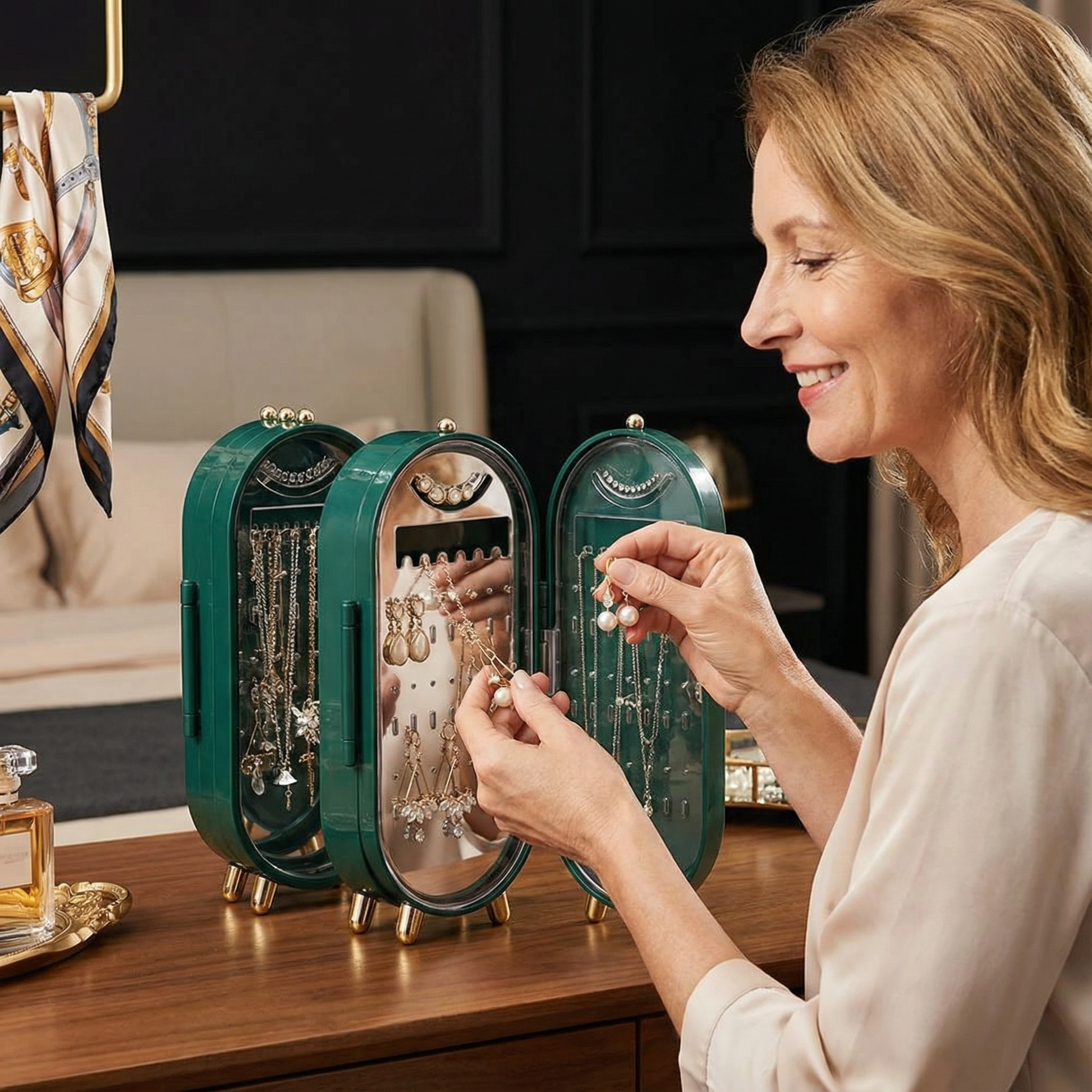
A folding jewelry organizer brings storage, visibility and a styling mirror together in one tabletop design.
The first sign is usually small. A necklace is placed on the dresser because it will probably be worn again the next morning. A pair of earrings is left beside it. A ring is set down near a bottle of perfume. None of these things looks like clutter by itself, and each decision feels temporary.
Then another necklace joins the first. One earring is moved while cleaning the surface. A bracelet is placed on top of a small dish that was already holding several rings. The jewelry box is still nearby, but the pieces used most frequently have gradually formed a second storage system outside it.
This is one of the more frustrating forms of everyday disorder because it often returns even after the room has been carefully tidied. The dresser can be cleared on Sunday and begin collecting jewelry again by Tuesday. The problem appears to be a lack of discipline, but the real cause may be simpler: the official storage location is less convenient than the nearest open surface.
Jewelry has a particularly difficult relationship with conventional storage. It is small enough to disappear, delicate enough to tangle and personal enough that choosing the right piece often requires seeing it against an outfit. A box may protect the collection while closed, yet still make the collection harder to use once the day begins.
That distinction is easy to overlook. We tend to judge storage by what it looks like when everything has already been put away. We notice the clean exterior, the closed lid and the empty surface around it. We pay less attention to what happens during the five minutes when someone is actually getting ready.
Those five minutes matter. They determine whether jewelry is easy to compare, whether unused pieces are returned immediately and whether the organizer becomes part of the routine or merely another container that looks tidy from the outside.
The jewelry box is often designed for storage, not for selection
Most traditional jewelry boxes begin with a reasonable idea: separate the collection into smaller spaces so pieces do not move around. The difficulty appears when those spaces are stacked, hidden behind drawers or placed underneath removable trays.
A layered box can hold a surprising amount, but capacity is not the same as accessibility. The earrings in the top tray are easy to use. The necklace underneath the tray requires an extra step. The ring at the back of a lower drawer may technically have a proper home, yet it can remain forgotten for months.
This creates a quiet hierarchy within the collection. The visible pieces are worn. The hidden pieces are ignored. Eventually, the most frequently used jewelry stops returning to the box because opening drawers and moving trays feels unnecessary when it will be needed again the next day.
The same issue appears with small dishes and open trays. They are convenient at first because nothing has to be opened. A ring can be dropped into the dish in a second. The difficulty is that every piece shares the same surface. Fine chains rest underneath heavier bracelets. Earring pairs separate. One item must be moved to reach another.
In other words, one solution hides too much while the other separates too little. The useful middle ground is a storage system that keeps jewelry visible without allowing every item to collect in the same place.
When earrings, necklaces and rings are divided between drawers and trays, comparing different pieces requires opening, closing and rearranging several parts of the organizer.
The more steps required to return an item, the more likely it is to remain on the dresser, bedside table or bathroom counter.
Rings, earrings and necklaces behave differently. A compartment that works for one category may be inconvenient for another.
Trying on a necklace or comparing earrings often means moving between the organizer and another part of the room.
Small inconveniences matter because they happen every day
A single extra step does not sound important. Opening a drawer, lifting a tray or walking to a mirror may take only a few seconds. But an organization system is not used once. It is used repeatedly, often at the busiest or most tired part of the day.
In the morning, jewelry may be one of the final decisions before leaving. Clothes are already chosen, a bag is being packed and there may be only a few minutes left. The necklace that is easiest to find often wins, even when another piece would work better.
At night, the priorities are different but the result can be the same. The goal is no longer to make a styling decision. It is simply to remove everything and move on. If putting each piece away requires opening multiple sections, the dresser becomes the temporary answer.
Temporary answers have a way of becoming permanent. The jewelry left out at night becomes the jewelry moved aside the next morning. The more crowded the surface becomes, the less obvious it is where any individual piece belongs.
This is why the best organization changes often feel surprisingly modest. They do not depend on having more discipline. They reduce the amount of discipline the routine requires.
Visibility is not the opposite of organization
There is a common belief that an organized room should hide as much as possible. Closed cabinets, solid drawers and opaque boxes create clean visual lines, so it is natural to assume that anything visible must be clutter.
But useful visibility is different from random exposure. A row of earrings displayed in separate positions is easier to understand than the same earrings mixed in a dish. Necklaces hanging individually can remain visually accessible without becoming a pile.
For objects that are chosen by appearance, visibility can be part of the function. Clothing works this way. A wardrobe becomes easier to use when colors, lengths and categories can be seen without emptying every shelf. Jewelry follows the same principle on a smaller scale.
Seeing the collection at once also changes how it is used. Pieces that would otherwise be forgotten can return to the rotation. Similar earrings can be compared side by side. A necklace can be considered with an outfit before another chain has to be untangled from it.
The objective is not to put every valuable item on permanent display. It is to create a visible working collection: the pieces used during a normal week, arranged in a way that makes both selection and return feel obvious.
Long-term storage and everyday storage do not have to be the same. Special-occasion pieces can remain in a more secure location while frequently worn jewelry stays in an organizer designed for quick daily access.
A mirror changes the role of the organizer
A built-in mirror can look like a secondary feature until the complete routine is considered. Jewelry is rarely chosen in isolation. A pair of earrings may work with one hairstyle and feel completely different with another. A necklace can appear balanced with one neckline and crowded with the next.
This means selection naturally includes a cycle: choose a piece, try it on, look in the mirror, keep it or return it. When the mirror is across the room, every rejected option creates another trip back to the storage area.
Those trips are not difficult, but they interrupt the process. Unused pieces may be placed temporarily near the mirror rather than returned immediately. By the time the final choice has been made, several earrings or necklaces can be spread across two different surfaces.
Bringing the mirror into the organizer shortens that loop. The collection can be viewed, a piece can be tried and an alternative can be returned without changing locations.
The value is not that the mirror replaces every larger mirror in the room. Its value is that it places visual feedback exactly where the jewelry decision is being made.
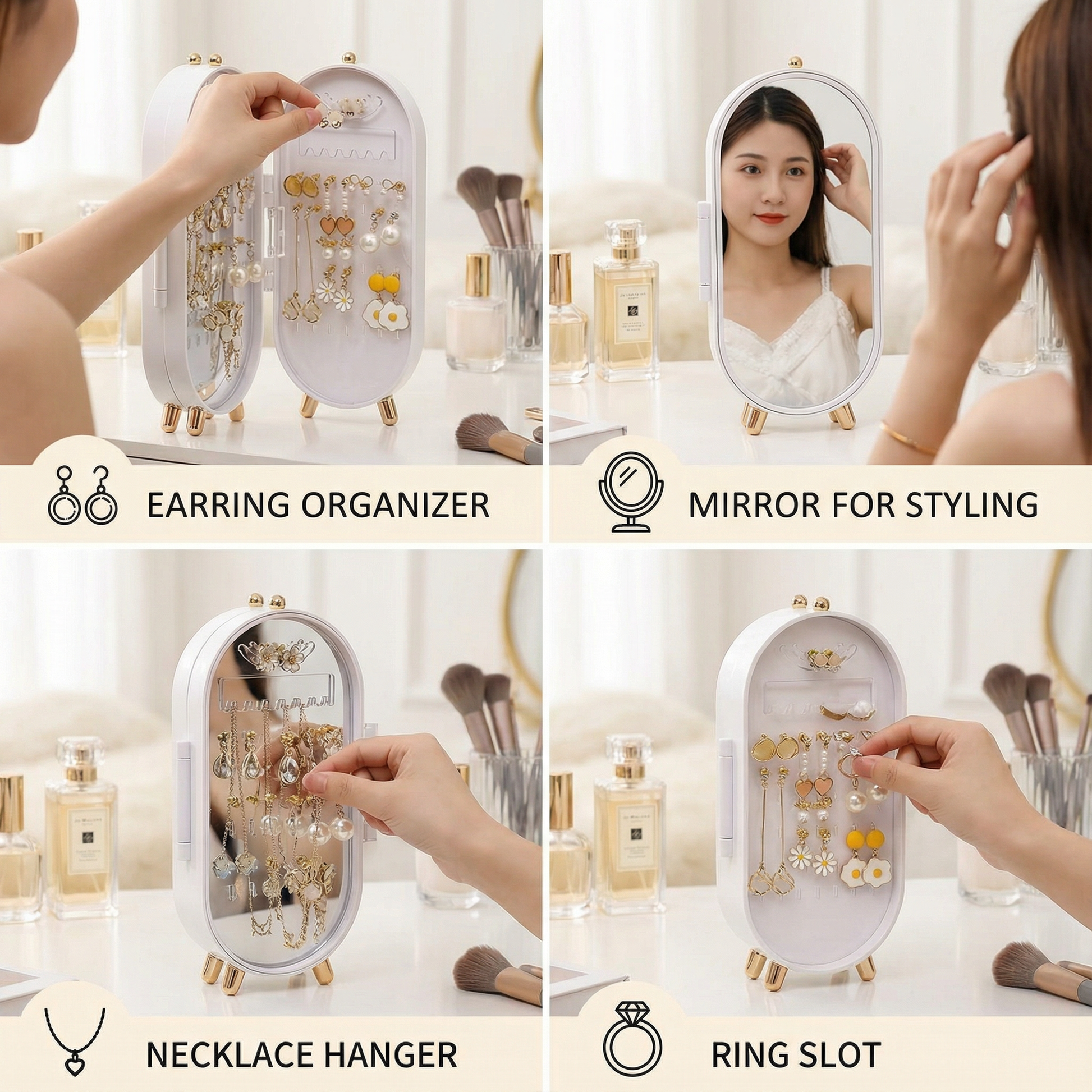
The interior is divided into areas intended for earrings, necklaces and rings, while one of the folding panels functions as a mirror.
The design question is not “How much can it hold?”
Capacity is usually the first specification people look for when considering a jewelry organizer. It is understandable. A box that cannot hold the intended collection is not useful.
Yet capacity alone can be misleading. A deep container may hold more pieces by allowing them to overlap. A series of compact vertical panels may hold fewer pieces in total while making every one of those pieces easier to see.
A better question is: How much of the collection can be used without moving everything else?
When one necklace can be removed without lifting three bracelets, the system is doing its job. When an earring can be returned without opening a second drawer, the system is doing its job. When the mirror is already available, the system is supporting the complete routine instead of only the final stage of storage.
This way of thinking favors structure over empty volume. Dedicated positions may appear less flexible than one large compartment, but they reduce the number of decisions required later.
Where necklaces hang, where earring pairs return, where rings are placed and where you can see the result after trying everything on. The less explanation the layout requires, the easier it is to maintain.
The folding format solves two competing needs
Jewelry is easier to use when it is spread out, but the room looks calmer when storage is compact. Those two preferences often conflict. An open display provides access but can take up visual space. A closed box looks tidy but can hide the collection.
A folding organizer moves between those two states. When opened, the panels create more visible storage surface than the closed footprint suggests. Different sections can face the user at the same time, reducing the need to search through layers.
When the routine is finished, the panels can be brought back together. The organizer becomes a smaller tabletop object rather than a permanent wall of jewelry.
That movement matters in bedrooms, bathrooms and dressing areas where the same surface may be used for several purposes. The vanity may also hold skincare, makeup, perfume, a hairbrush and the objects emptied from a bag at the end of the day. Storage that can expand temporarily and contract afterward makes better use of limited space.
It also gives the owner a clear signal that the routine is complete. Open means jewelry is being selected. Closed means unused pieces have returned to their place.
The difference is measured in fewer interruptions
Imagine that the outfit is already chosen and there are seven minutes before leaving. The first pair of earrings looks too formal. The second works better, but now the necklace feels unnecessary.
With a traditional layered box, the first earrings may be left beside the mirror while the second pair is retrieved. The necklace may be returned to a different drawer. By the time the final decision is made, the surface holds several rejected options.
With a visible folding organizer, the first pair can return to its position before the second is removed. The necklace can be hung back in place while the mirror remains directly in front of the collection. The same decisions still happen, but they create less movement and fewer temporary piles.
The evening routine may be even more important
Organization advice often focuses on the morning because that is when belongings are selected. But the condition of the dresser is usually decided at night.
Jewelry removed before washing, changing clothes or going to bed tends to land at the nearest safe-looking location. If the organizer is closed inside a drawer, a dish on the bedside table may be more convenient. If necklaces require careful coiling, they may be left hanging from a handle or placed on top of another object.
A visible organizer can reduce that gap between the place where jewelry is removed and the place where it belongs. Earrings can return to a designated section. A necklace can be hung rather than folded. Rings can be placed in the same area each night.
Consistency is valuable because small jewelry is not difficult to lose when it is being worn; it is difficult to find after it has been removed in a different location several evenings in a row.
The goal is not a perfect nightly ritual. It is a storage location simple enough that using it feels easier than creating a temporary alternative.
The product considered
How AERQUILT’s folding jewelry storage box approaches the problem
The Elegant Jewelry Storage Box With Mirror uses a folding, multi-panel format rather than a single deep compartment. When opened, the panels reveal separate areas intended for different kinds of jewelry, along with an integrated mirror.
The design is aimed at the part of a collection that benefits from visibility: earrings that are easier to compare as pairs, necklaces that are better kept apart, rings that need a consistent return point and small accessories that can disappear inside a larger box.
Its most useful characteristic is the relationship between those sections. The mirror is not a separate accessory stored nearby. It is part of the same folding structure, so selecting and evaluating a piece happen in one location.
The panels also allow the organizer to shift between two roles. Open, it functions as a small jewelry station. Closed, it takes the form of a compact decorative object that can remain on a dresser or vanity.
AERQUILT currently presents the organizer in green and white. The green version has a deeper, more prominent appearance, while the white version creates a lighter and more neutral impression.
This is not necessarily intended to replace every form of jewelry storage. Someone with a large collection may still want a separate cabinet or secure box for pieces used less frequently. The folding organizer makes the most sense as an accessible home for the jewelry that is regularly in rotation.
Matching pairs can remain near one another instead of collecting together at the bottom of a tray.
Vertical storage avoids the need to coil several chains into the same compartment and makes individual pieces easier to identify.
A defined area is easier to remember than moving rings between a bathroom counter, bedside dish and dresser.
Jewelry can be tried on and compared without creating a separate pile beside another mirror.
Multiple parts of the collection can be viewed at once instead of being hidden underneath stacked trays.
The same structure that provides visibility during the routine becomes more compact when the routine is finished.
Who is likely to find this format useful?
The strongest fit is someone with a moderate collection of jewelry that is worn regularly. This may include several pairs of earrings, a selection of necklaces, favorite rings and a few bracelets or small accessories.
It can also suit someone whose jewelry is currently divided between several informal locations. A dish may hold rings, a drawer may hold necklaces and the most frequently worn earrings may remain beside a mirror. Bringing those pieces into one visible station can make the routine feel more consistent.
Small dressing areas may benefit as well. When there is not enough room for both a large jewelry cabinet and a separate tabletop mirror, combining the functions can preserve more usable surface.
The organizer may also appeal to someone who likes the accessibility of an open jewelry display but prefers to close the collection when it is not being used.
It is less suitable for someone expecting one compact product to hold a very large collection of bulky bracelets, watches or statement necklaces. Those pieces may require additional space and a different style of storage.
The useful question is not whether every piece you own can fit. It is whether the organizer can comfortably hold the pieces you want to see and use most often.
A working collection can be more useful than complete storage
Many wardrobes operate more smoothly when the current season is easy to reach and the rest is stored elsewhere. Jewelry can be approached in the same way.
Instead of trying to place every accessory into one organizer, choose the pieces that belong to your normal week. These might be the earrings that work with most outfits, necklaces that layer easily, rings worn regularly and a few options for evenings or special plans.
Less frequently used jewelry can remain in long-term storage. This prevents the daily organizer from becoming crowded and keeps the visible collection easier to understand.
The selection can also change. A lighter group of accessories may be placed in the organizer during summer, while darker metals or more substantial pieces move forward in winter. The organizer becomes an active part of the wardrobe rather than a permanent archive.
This approach makes it easier to notice which pieces are genuinely being worn. Jewelry that remains in the daily organizer for months without being selected can be moved back into storage, creating room for something else.
Placement determines whether the organizer becomes a habit
Even a well-designed product can fail when it is placed in the wrong location. The organizer should sit near the point where jewelry is normally selected and removed.
For some people, that is a bedroom dresser. For others, it is a vanity near skincare and makeup. The best location may not be the most photogenic location in the room. It is the location that naturally appears during the existing routine.
The organizer should also have enough surrounding space to open comfortably. If bottles, brushes and other objects block the folding panels, using the interior will require rearranging the surface first. That extra work can send frequently worn jewelry back to the nearest dish.
A small amount of intentional empty space can therefore be more useful than filling every inch of the dresser. The organizer does not need a large area, but it should be able to move between its open and closed positions without becoming an obstacle.
Once the location is chosen, keeping it consistent is important. A storage system is easiest to remember when it does not move around the room.
How to organize the interior without overfilling it
The temptation with any new organizer is to fill every available position immediately. This creates a satisfying sense of completion, but it can reduce the visibility that made the organizer useful in the first place.
Begin with the pieces worn most often. Place everyday earrings where they can be seen clearly. Give fine necklaces enough separation that one can be removed without disturbing the others. Keep rings in a consistent section rather than using several different areas.
Leave a small amount of open room. Empty space is not wasted capacity. It creates visual separation and makes it easier to add a new piece without reorganizing the entire interior.
It may also help to group jewelry by the way it is chosen rather than by its value. Earrings worn to work can stay near one another. Necklaces that layer well can be positioned close together. A small group of evening pieces can occupy another section.
The objective is not to create a display that remains perfectly symmetrical. It is to create an arrangement you can understand in a few seconds.
One object can perform several roles
Limited space makes specialized furniture difficult. A separate jewelry cabinet, tabletop mirror and display stand may each be useful, but together they can occupy most of a small dressing area.
A folding organizer combines part of those functions. It provides visible storage while open, a mirror during the routine and a compact form afterward.
It does not eliminate the need for all other storage, but it can reduce the number of separate objects required for the jewelry worn most frequently.
Green or white is more than a color decision
Because the organizer is designed to remain visible on a dresser or vanity, its exterior becomes part of the room rather than something hidden inside a drawer.
The green version creates a stronger focal point. Its deeper color can work well with darker wood, brass-colored accents, jewel tones or a room where the organizer is intended to feel decorative.
The white version is quieter. It may blend more naturally with light furniture, neutral bedrooms, bright bathrooms or dressing spaces where the surrounding objects already provide enough color.
Neither option changes the basic function. The decision is mainly about whether the organizer should stand out or visually recede into the surface around it.
Looking at the area where it will be placed can make the choice easier than trying to select a favorite color in isolation.
It can also work as a practical gift
Jewelry itself can be difficult to give because taste, sizing and metal preferences are personal. Jewelry storage is often easier because it supports pieces the recipient has already chosen.
A folding organizer may suit someone moving into a new home, creating a first dressing area, reorganizing a bedroom or beginning to build a jewelry collection.
It can also be paired with one small piece of jewelry rather than replacing the gift itself. The organizer gives that piece a visible place and continues to be useful as the collection grows.
As with any storage gift, it helps to consider the recipient’s habits. Someone who wears earrings and necklaces regularly may benefit more than someone whose collection consists mainly of large watches or heavy bracelets.
The larger lesson is about reducing friction
Jewelry clutter is rarely caused by a single dramatic mistake. It develops through a series of reasonable decisions: placing something nearby, planning to return it later, choosing the easiest visible option and postponing the work of untangling the rest.
That is why the solution does not need to be dramatic either. The most effective change may simply be placing storage, display and a mirror in the same location.
When the organizer reflects the actual routine, returning a necklace does not feel like a separate task. Trying on earrings does not create another pile. Closing the panels becomes the final step rather than the beginning of a longer cleanup.
The result is not only a tidier dresser. It is a collection that is easier to see and therefore easier to use.
For anyone who regularly reaches for the same few pieces because the rest are hidden, searches for an earring that was placed somewhere “safe,” or leaves necklaces out because putting them away feels inconvenient, a more visible folding organizer may be a meaningful improvement.
Frequently considered questions
What to know before choosing this type of organizer
Is it intended to hold an entire jewelry collection?
It is likely to be most useful as an organizer for frequently worn earrings, necklaces, rings and other small accessories. Someone with a large collection may prefer to use it alongside additional long-term storage.
Does the organizer include a mirror?
Yes. The product includes an integrated mirror so jewelry can be tried on and compared in the same place where it is stored.
What jewelry types is the interior designed for?
The product page presents storage areas for earrings, necklaces, rings, bracelets and other small pieces. The exact amount that fits will depend on the size and shape of the individual jewelry.
Which colors are currently offered?
The official product page currently lists green and white. Because availability can change, the latest options should be confirmed on the product page before ordering.
Will the folding panels require extra space?
The organizer is compact when closed but needs some surrounding surface space when opened. It is best placed where the panels can move without being blocked by bottles, brushes or other objects.
Can it replace a full-length or wall mirror?
The integrated mirror is intended for close-up styling and trying on accessories. A larger mirror may still be preferred for viewing a complete outfit.
Is it only suitable for a bedroom?
It can be placed in a bedroom, dressing area, bathroom vanity area or another tabletop location where jewelry is normally selected and removed, provided the environment is appropriate for the jewelry being stored.
How can the organizer be kept from becoming overcrowded?
Start with the jewelry worn most frequently and leave a small amount of open space between pieces. Less frequently used or bulkier items can remain in separate storage.
Where can current shipping and return information be found?
Current shipping, payment, return and customer-service information should be reviewed directly on the official AERQUILT website before completing an order.
Make the easiest place to use your jewelry the easiest place to put it back.
The AERQUILT Elegant Jewelry Storage Box With Mirror brings visible jewelry storage and a styling mirror together in a folding tabletop design.
See Current Colors and Details