-180x.png?w=180&h=47)
Storage without structure
Items share broad cavities. The available volume may be generous, but the contents overlap and become harder to scan.
The overlooked problem is not how much jewelry you own. It is how conventional storage forces rings, chains, watches and earrings into the same visual blind spot.
There is a familiar ritual that happens at dressing tables every morning. A person opens a jewelry box, lifts one bracelet, moves a watch, separates two chains and searches for the second earring that was visible yesterday. The collection may be modest, carefully chosen and genuinely loved. Yet the storage makes it behave like clutter.
Most traditional boxes solve only one problem: they provide a place to put jewelry. They do not necessarily solve the more important problem of retrieval. A deep compartment keeps objects off the table, but it also places one object on top of another. What looks orderly from the outside can become a compressed stack of metal, stones, straps and fine chains on the inside.
That distinction matters because jewelry is unusually dependent on visibility. Clothing hangs in recognizable shapes. Shoes sit in pairs. Jewelry is smaller, more reflective and easier to overlap. Once an item drops beneath another layer, it can effectively disappear from daily life even though it remains only a few inches away.
The result is a quiet mismatch between ownership and use. You may own several rings, multiple pairs of earrings and a watch for different occasions, yet still reach for the same two or three pieces. Not because they are always the best choice, but because they are the easiest to reach.
A box can be technically full and still be functionally empty. When choosing an accessory requires untangling, removing several pieces or checking multiple corners, the path of least resistance wins. People reach for the same visible ring, the same watch and the same pair of earrings.
This is why a useful organizer should be judged by more than capacity. The better question is whether it improves visual access. A practical system reduces the number of movements between opening a container and selecting an item. The fewer objects that must be shifted, the more likely the collection is to be used broadly rather than selectively.
In practical terms, the best organizer behaves partly like a display. Rings remain upright. Earring pairs stay together. Broad trays hold watches and bracelets without forcing them into narrow slots. Necklaces occupy enough separate space to reduce unnecessary contact with one another.
This does not mean every piece must be permanently exposed. It means the organizer should reveal the collection clearly when opened and allow it to disappear neatly when closed. That balance—visibility during use, compactness afterward—is where many conventional boxes fall short.
Large compartments appear flexible because they can hold almost anything. But that flexibility transfers the work to the owner. Rings, earrings, bracelets and chains must be arranged manually, and the arrangement often collapses as soon as one item is removed.
Small objects slide under larger ones. Watch straps create awkward barriers. Fine chains settle into corners. Earrings separate because there is no dedicated place to keep them paired. The box remains capable of holding the collection, but it stops helping the owner understand where anything is.
Items share broad cavities. The available volume may be generous, but the contents overlap and become harder to scan.
Separate levels and compartments create predictable places for different categories, reducing searching and accidental tangling.
The difference is not cosmetic. Structure creates memory. When rings always return to one zone and watches to another, the organizer becomes easier to maintain because the correct location is obvious.
Open your current jewelry box and choose one item from the bottom without moving anything else. If that is impossible, the box is storing your collection but not truly organizing it.
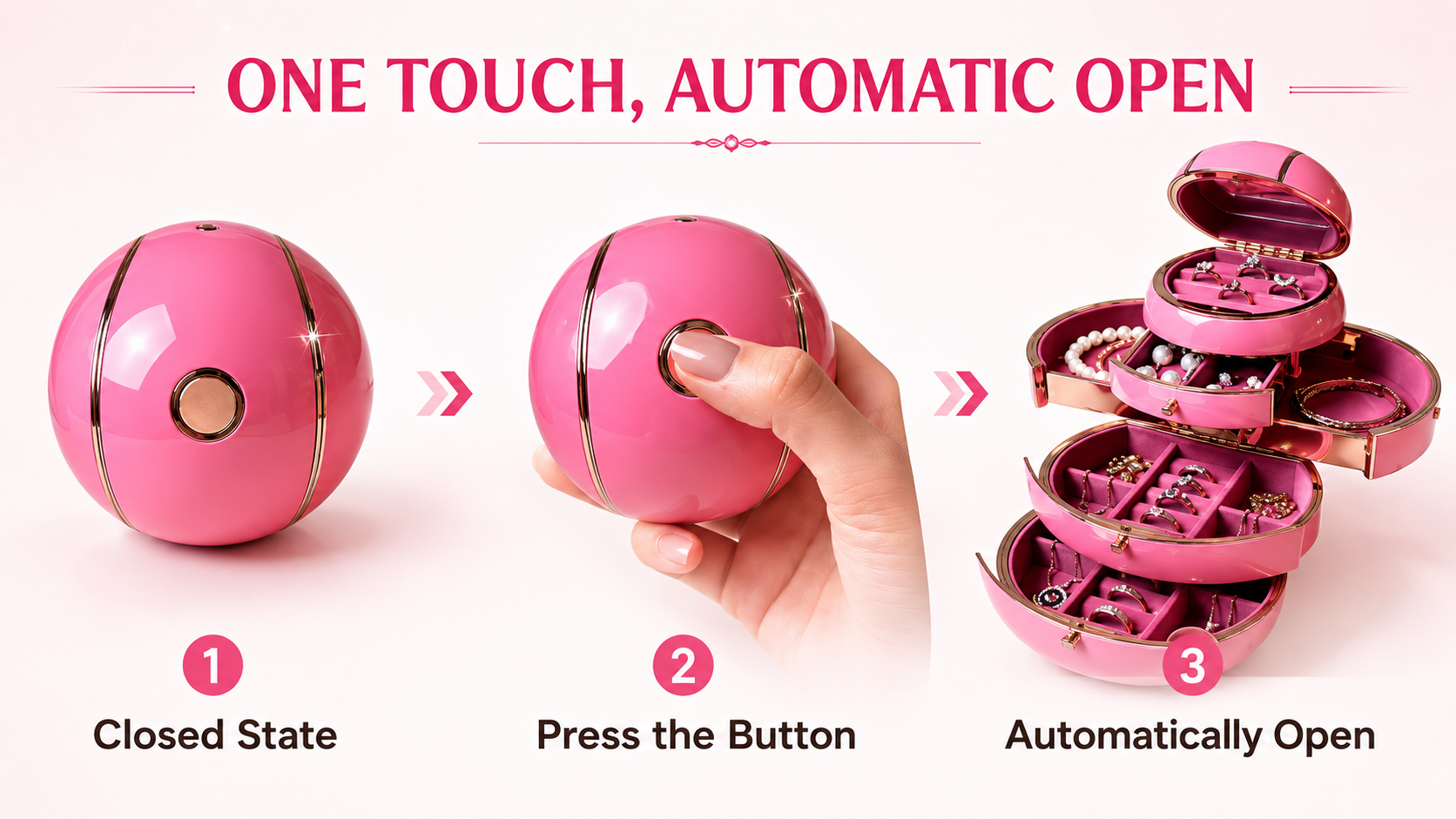
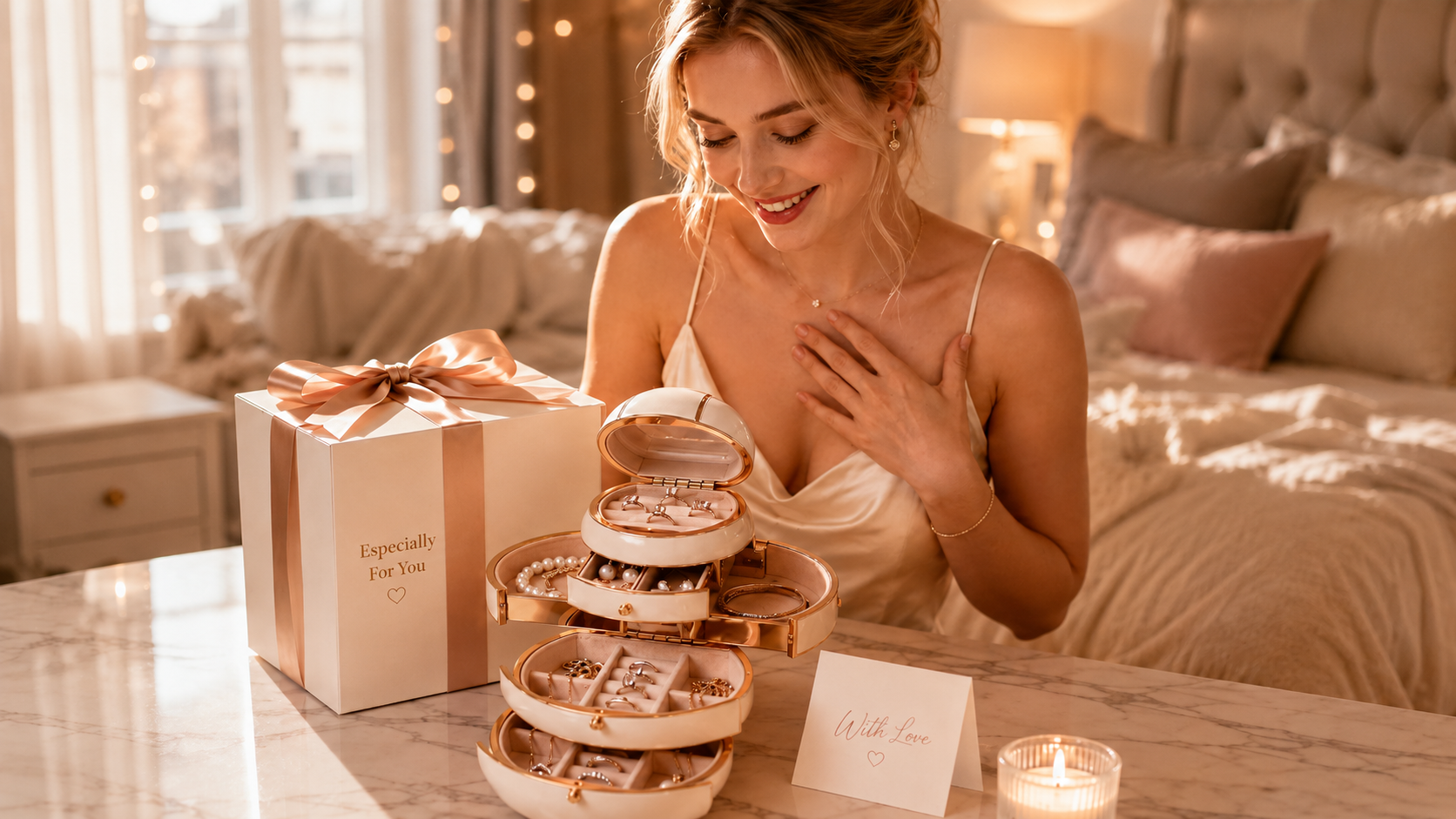
The AERQUILT Automatic Deformable Spherical Jewelry Box approaches the problem differently. Closed, it has the footprint and appearance of a compact decorative object. Pressed open, its storage levels move outward, revealing several zones at once.
The value of the mechanism is not movement for its own sake. It is the change in information. Instead of looking down into one deep cavity, the user sees a tiered arrangement. More of the collection becomes readable in a single glance, which reduces searching and makes category separation easier to maintain.
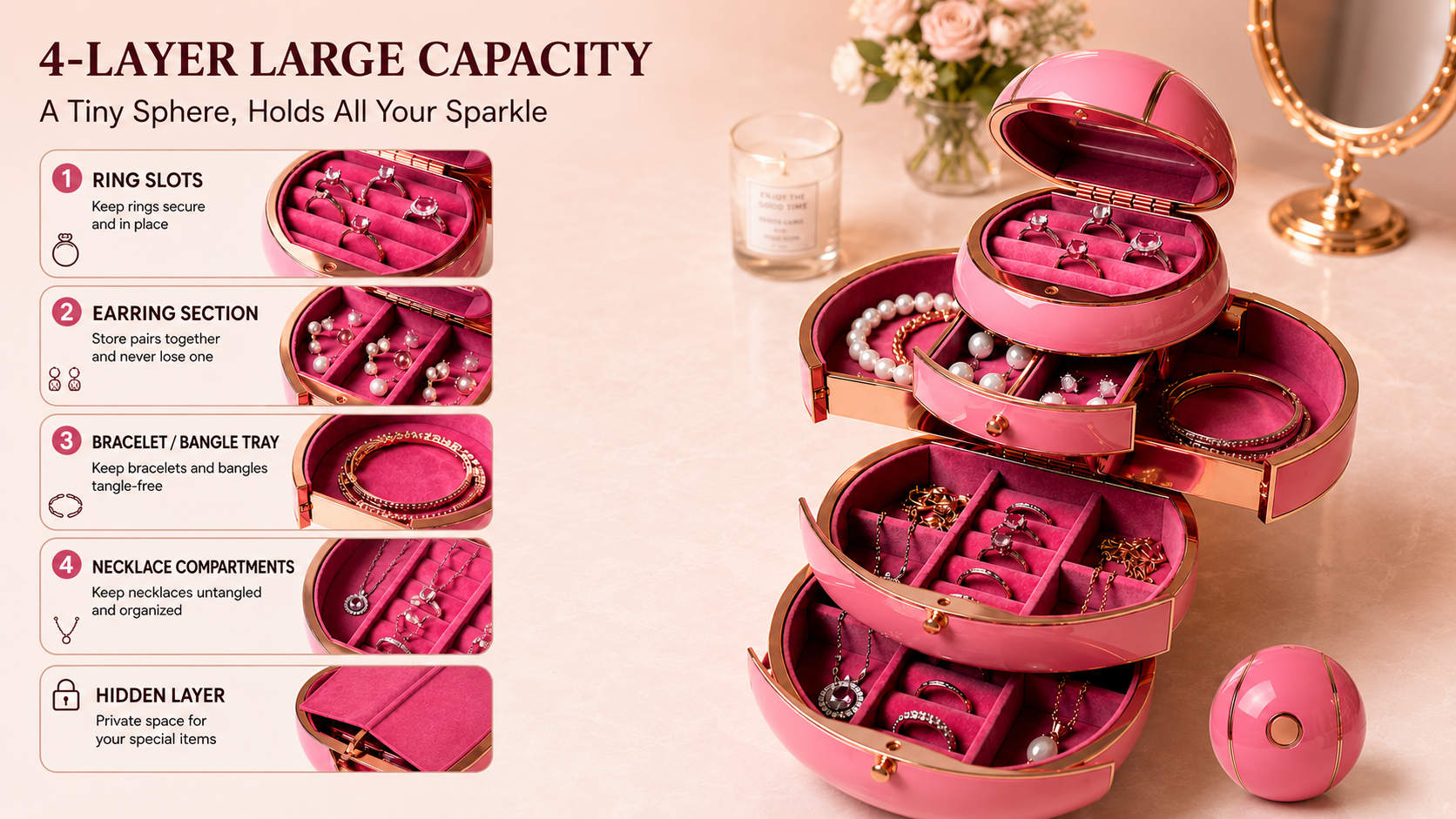
The closed shape also changes how the object lives in a room. A rectangular organizer often reads as storage equipment. A sphere reads more like a decorative accent. On a vanity or bedside table, that distinction can matter because the organizer remains visible even when it is not being used.
A moving organizer can easily become a gimmick if the mechanism is more memorable than the storage. The practical question is what appears after the sphere opens. Here, multiple trays create separate surfaces for different jewelry types rather than presenting one dramatic motion followed by another undivided cavity.
Necklaces and fine chains still require sensible placement. No compact organizer can completely prevent tangling if several long chains are dropped together. But separate levels give the owner more control over contact points and reduce the tendency for every category to collapse into one pile.
The opening action is created by a spring-assisted mechanical structure. There is no app, battery or charging cable. The user presses the top, allows the levels to unfold, chooses an item and closes the form again.
That simplicity matters because jewelry storage is a daily routine, not a technology demonstration. A useful organizer should not require maintenance beyond ordinary cleaning and careful handling. It should feel immediate in the morning and unobtrusive at night.
As with any articulated organizer, weight should be distributed reasonably across the trays. Heavy watches should not all sit on one side while the opposite levels remain empty. The mechanism should be opened and closed with a controlled motion rather than forced.
This is not a limitation unique to the design. It is basic care for any object with moving parts. The reward is that the organizer can remain compact when closed while still presenting several levels when opened.
Hard storage surfaces can create repeated contact against polished metal, stones and watch faces. The AERQUILT trays use a soft velvet-style lining intended to reduce everyday friction and help small pieces remain in place.
This does not eliminate the need for sensible jewelry care. Fine chains should still be separated. Fragile stones should not be compressed beneath heavier watches. Silver pieces may require appropriate anti-tarnish storage, and especially valuable jewelry may need individual cases or secure storage.
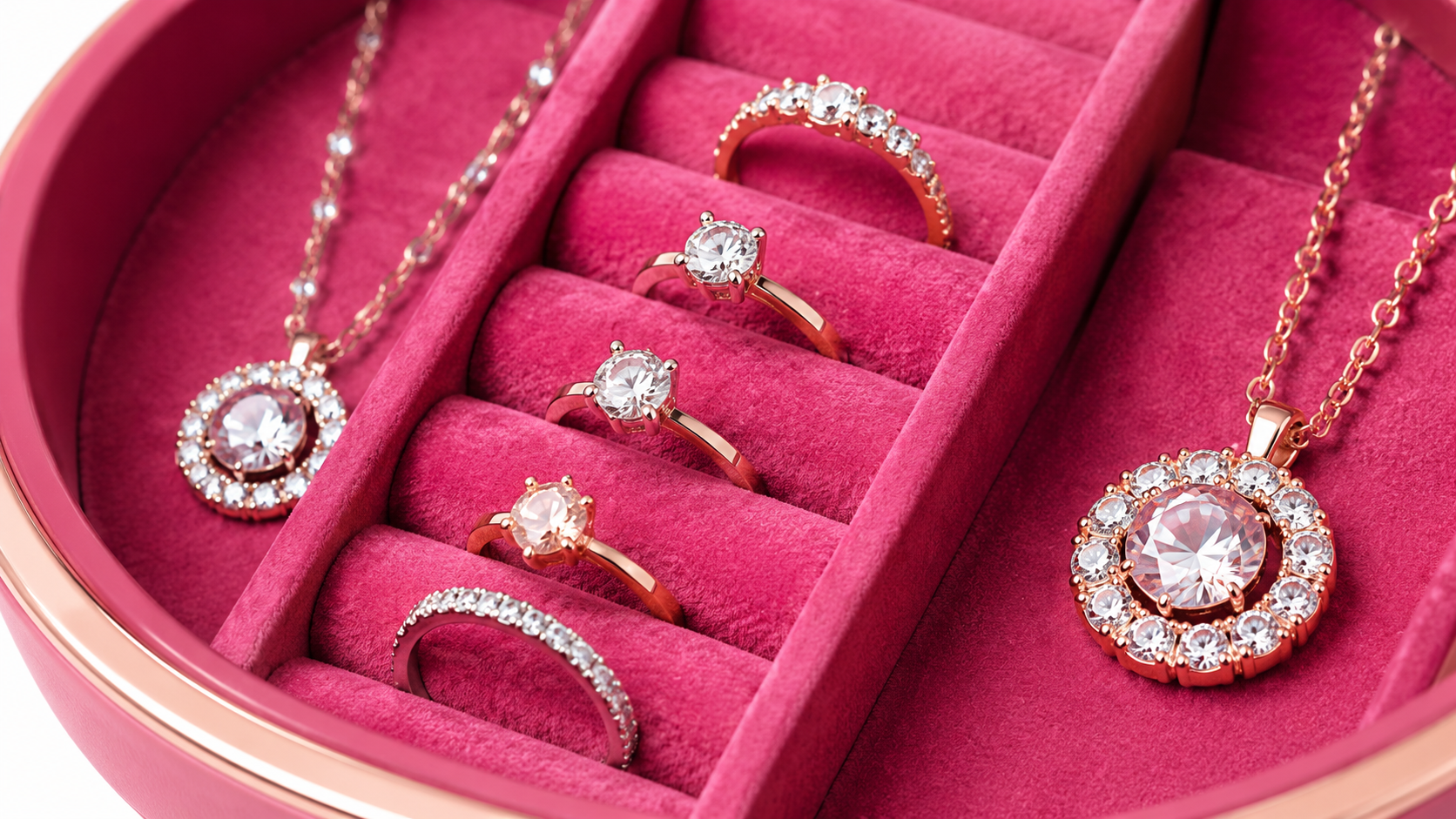
The important point is proportion. Everyday pieces need an everyday level of protection: separated surfaces, softer contact and enough room to avoid pressure. The organizer is designed around that ordinary use case rather than around archival storage.
Do not fill every available space simply because it exists. An organizer works best when the contents remain visible and removable without disturbing neighboring pieces.
Jewelry often accumulates at the edges of a room: on a bedside table, near a sink, beside a mirror or in the shallow dish where items are placed at the end of the day. Each individual piece is small, but together they create visual noise.
A closed spherical organizer consolidates that noise into one form. The surface remains visually simple, while the interior can stay divided by function. This is particularly useful in bedrooms and dressing areas where large rectangular organizers may occupy more visual space than their actual dimensions suggest.
The design is not minimalism in the strict sense. It does not ask the owner to reduce the collection. It simply gives the collection a clearer boundary.
Good organization is less about a major weekend clean-up than about a repeatable thirty-second habit. Remove jewelry, open the organizer, return each piece to its category, and close the sphere. The next morning begins with a visible collection instead of a recovery operation.
The method is simple, but consistency matters. Once every category has a home, returning an item becomes easier than leaving it loose.
No organizer is universally suitable. A person with six everyday pieces has different needs from someone storing several watches, layered necklaces and occasion jewelry. A compact spherical design is most effective when its size is selected honestly rather than aesthetically.
A common buying mistake is choosing the smallest size because it looks neat when empty. Once overloaded, however, even a well-designed organizer becomes difficult to use. The correct size should allow some breathing room around the collection.
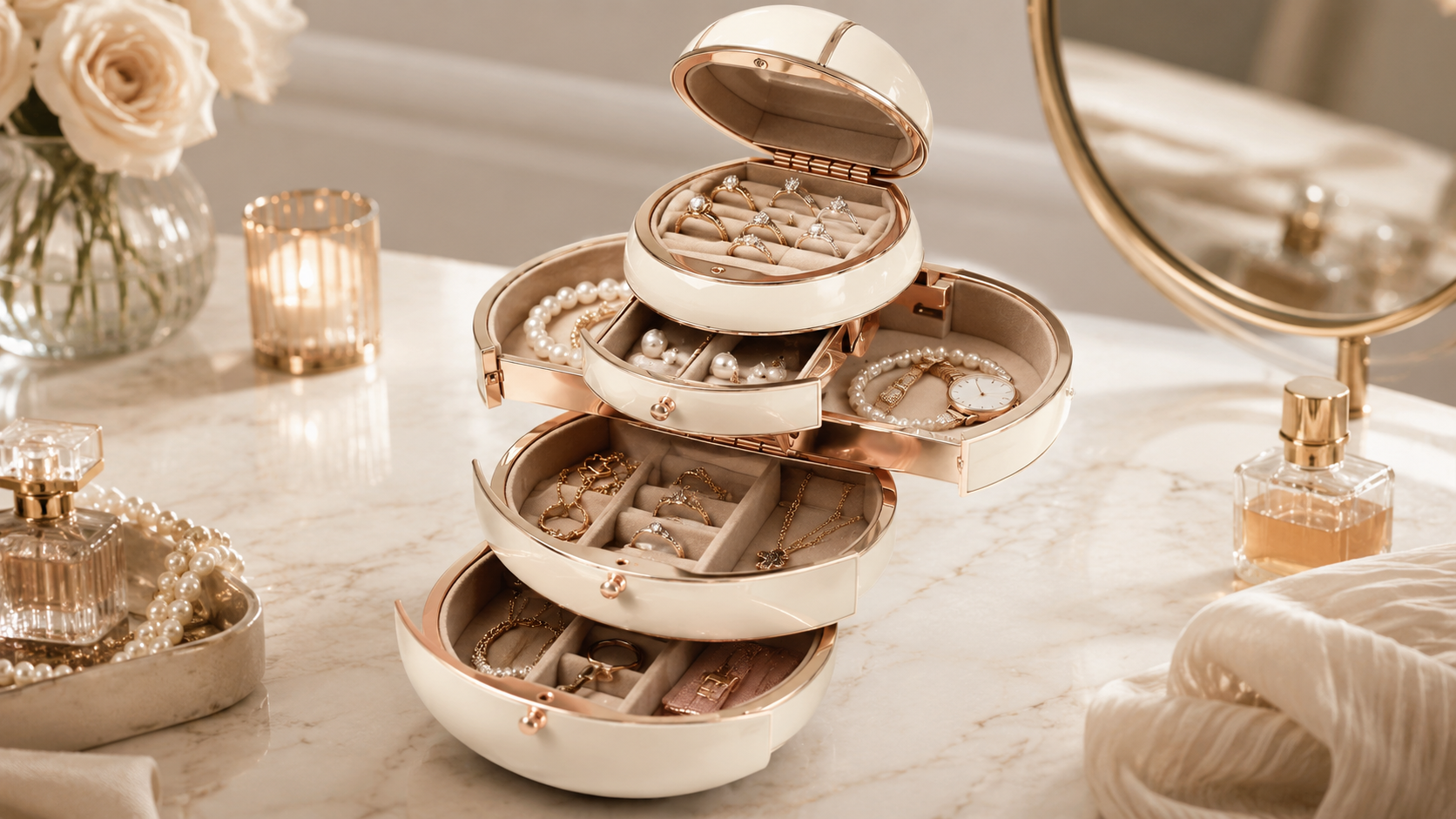
The rose-pink version gives the organizer a stronger presence than a neutral white or champagne finish. Its glossy surface and metallic details make it read as an accessory in its own right rather than as a purely functional container.
That makes it especially suitable for rooms that already use blush, rose, cream, brass or warm neutral tones. The color can also work as a deliberate accent on a simpler dresser, where one saturated object is more controlled than several small decorative pieces.
For buyers who prefer a quieter effect, the organizer is also offered in other finishes. Color should support the room rather than compete with it.
The AERQUILT design is intended for visible, everyday organization. It is not a safe, a travel vault or a professional archival system. It will not replace individual protective cases for highly valuable stones, antique pieces or materials with specialized storage requirements.
Its strength is more ordinary and more relevant to many owners: it makes a mixed personal collection easier to see, easier to separate and easier to return to order.
Everyday rings, earrings, bracelets, watches, small necklaces, vanity organization and decorative bedside storage.
Large archival collections, high-security storage, long travel with fragile pieces or jewelry requiring individual climate-controlled protection.
It is most relevant for someone who owns a small-to-medium jewelry collection, uses a dresser or vanity regularly and wants fast visual access without leaving everything exposed. It also suits gift buyers looking for something more distinctive than a conventional rectangular box.
It is less appropriate for someone who dislikes decorative objects, needs maximum capacity in the smallest possible volume or stores a very large fine-jewelry archive.
Product specifications, available variants, price and stock should be confirmed on the official product page before purchase.
Ignore the opening motion for a moment. Count the pieces you use in a normal month. Group them into rings, earrings, necklaces, bracelets and watches. Then ask whether each category has enough space to remain visible.
Next, consider the room. Measure the surface where the organizer will sit. Decide whether the closed sphere should blend into the surroundings or act as a color accent. Finally, think about your actual routine: do you remove jewelry in one consistent place, or do pieces migrate around the house?
If the answers remain favorable after that exercise, the organizer is doing more than offering novelty. It is solving a recurring retrieval problem in a compact form.
Jewelry boxes are common gifts, but many feel generic because their function is immediately obvious and their form is familiar. The spherical design changes that first impression. Closed, it creates curiosity. Opened, it reveals a practical layered interior.
That combination makes it suitable for birthdays, anniversaries, graduations, Mother’s Day, Valentine’s Day or a new-home gift—provided the recipient actually wears jewelry and has a suitable surface for it.
The safest gift choice is usually a medium capacity in a color that matches the recipient’s room or personal style. A highly saturated rose finish is expressive; white or champagne may be easier when the décor is unknown.
Objects become part of daily life when they are easy to reach, easy to understand and easy to put away. Jewelry boxes often fail at the third step. They accept the object, but they do not make the return location obvious.
A layered organizer reduces that uncertainty. The ring zone looks like the ring zone. The wider tray naturally receives the watch. The collection becomes a small system rather than a miscellaneous container.
That is the strongest argument for this design. The pink sphere may attract attention, and the opening motion may create the first moment of interest. But the lasting value depends on whether the owner can find a piece quickly, return it easily and keep the surrounding surface calm.
No. The unfolding action is mechanical, so there is no app, battery or charging cable involved.
It can accommodate selected necklaces, but long or very fine chains should be placed carefully and separated to reduce tangling.
Choose according to the number and type of pieces you use regularly. Small suits a curated rotation, medium suits most mixed collections, and large provides more room for broader collections.
No. The product is presented in several finishes, including Pink, Blue, Purple, Champagne and White. Current availability should be confirmed on the product page.
It is intended as an everyday organizer, not a secure safe or archival storage system. High-value or fragile pieces may require specialized individual cases.
Use a soft, dry cloth on the exterior and treat the lined interior gently. Avoid soaking the mechanism or using harsh abrasive cleaners.
Current variants, specifications, pricing and stock are listed on the official AERQUILT product page.
Review the current product details, select the capacity that matches your collection and confirm availability directly on the AERQUILT product page.
Check Availability →
loading